SCIENCE MAKES THE CASE
The science is clear: weather observations are essential to accurate forecasts, and closing gaps where data are scarce can deliver benefits far beyond national borders. As forecasting technologies advance, research is also revealing why the quality, availability and sustained sharing of observations matter more than ever.
Measuring the impact of observations
Over the past three years, the European Centre for Medium-Range Weather Forecasts (ECMWF), in collaboration with WMO and SOFF, has investigated how closing critical weather observation gaps can improve forecast accuracy.
The findings show that additional observations in data-sparse regions improve forecasts from the next few hours to several days ahead, with benefits reaching far beyond national borders.
Significant gains in forecast accuracy
Adding surface and upper-air observations in resource-constrained countries can reduce forecast uncertainty by more than 30% in parts of Africa and up to 20% in the Pacific.
Source: ECMWF / WMO
Source: ECMWF / WMO
Better forecasts up to 7 days ahead
More than 3 billion people live in the tropics, a region covering around 40% of the Earth's surface and exposed to weather hazards ranging from tropical cyclones to intense rainfall.
ECMWF found that closing weather observation gaps in developing countries and Small Island Developing States could improve forecasts of upper-air temperature, humidity and wind across the tropics up to seven days ahead. For a region of this scale, even modest improvements in forecast accuracy can provide valuable information for earlier planning and preparedness.
From Africa to the Atlantic
Around 60% of Atlantic tropical cyclones develop from atmospheric disturbances known as African Easterly Waves, which originate over Africa.
The studies found that additional observations in Africa improve forecasts of atmospheric conditions in the Atlantic hurricane development region up to five days ahead. This shows how strengthening observation networks in one region can improve weather prediction thousands of kilometres away, including for communities vulnerable to Atlantic hurricanes.
The findings make a compelling case for data justice: investing in observations where they are most needed improve forecasts both locally and across the world.
Building on a weakening foundation: the observation gap in AI forecasting
Artificial intelligence is rapidly transforming weather and climate prediction. But a 2026 scientific article warns of a growing paradox: the technology is advancing while the observation networks it depends on are becoming increasingly sparse and unequal.
AI learns from data. Gaps, errors and biases can be reproduced — and potentially amplified — by models. Extreme events such as floods and droughts present an additional challenge because they are already poorly represented in many observational records.
Why in-situ observations matter
Satellites and increasingly sophisticated models cannot simply replace what is missing on the ground. Satellite products, reanalysis datasets and hydrological models all depend on in-situ measurements to help ensure their accuracy.
Research published in 2026 shows that the availability of openly shared in-situ hydrometeorological data has declined over recent decades, driven by station closures and reduced data sharing. The places with the largest observation gaps risk being those least able to benefit from advances in AI, reinforcing existing inequalities in forecasting capacity.
The next generation of forecasting cannot be built on a weakening foundation. Investing in AI must also mean investing in the observations it needs to maximize its benefits.
Schematic illustration of the importance of (and vulnerability to) in situ measurements in hydrometeorological AI. Source: npj Natural Hazards
Schematic illustration of the importance of (and vulnerability to) in situ measurements in hydrometeorological AI. Source: npj Natural Hazards
The science behind trustworthy data
Every weather forecast depends on millions of observations. But what makes these observations trustworthy? The European Centre for Medium-Range Weather Forecasts (ECMWF) explains in a recent article that collecting data is only the beginning. Reliable forecasts depend on three essential ingredients.
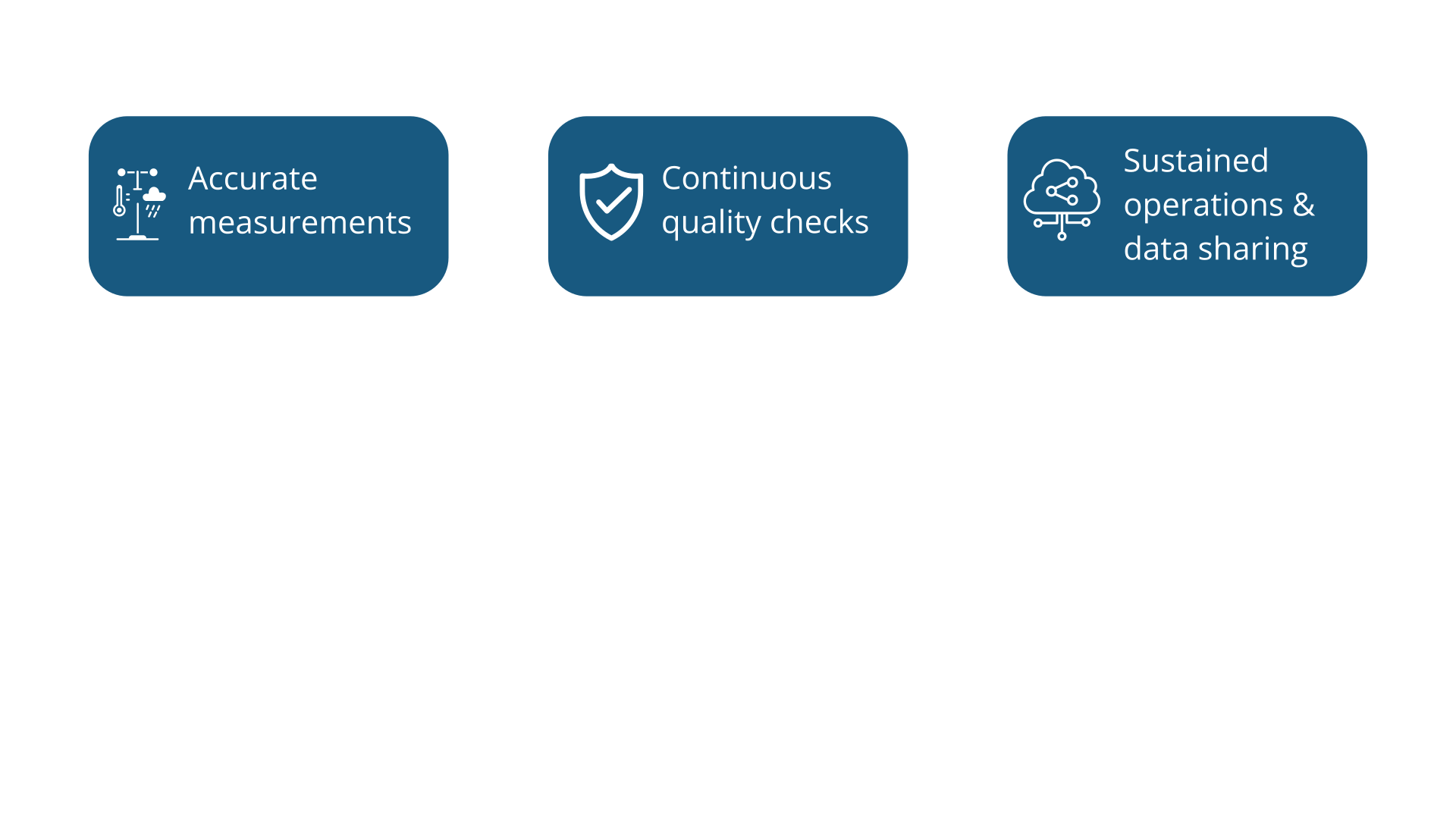
Trust begins with instruments that measure atmospheric conditions correctly. Equipment must be properly installed, operated and maintained to produce reliable observations. Even a single incorrect measurement can make a difference. ECMWF documented how erroneous data from a ship affected its analysis of Tropical Cyclone Noul. Once the error was identified and excluded, the analysis improved.
SOFF supports countries in installing and upgrading surface and upper-air observing stations, and operating them in a sustained manner, helping strengthen the foundations of reliable weather data.
Observations cannot simply be collected and assumed to be correct. Their availability and quality must be continuously monitored to detect missing data, errors and inconsistencies.
Through WMO's Data Quality Monitoring System (WDQMS), global forecasting centres, including ECMWF, contribute to monitoring observations and identifying problems that national meteorological services can address.
As SOFF Technical Authority, WMO provides the independent technical oversight that connects international GBON requirements with country-level implementation. It guides countries and their partners, reviews national plans and investment decisions against GBON regulations and independently verifies progress towards compliance.
 Built with Shorthand